
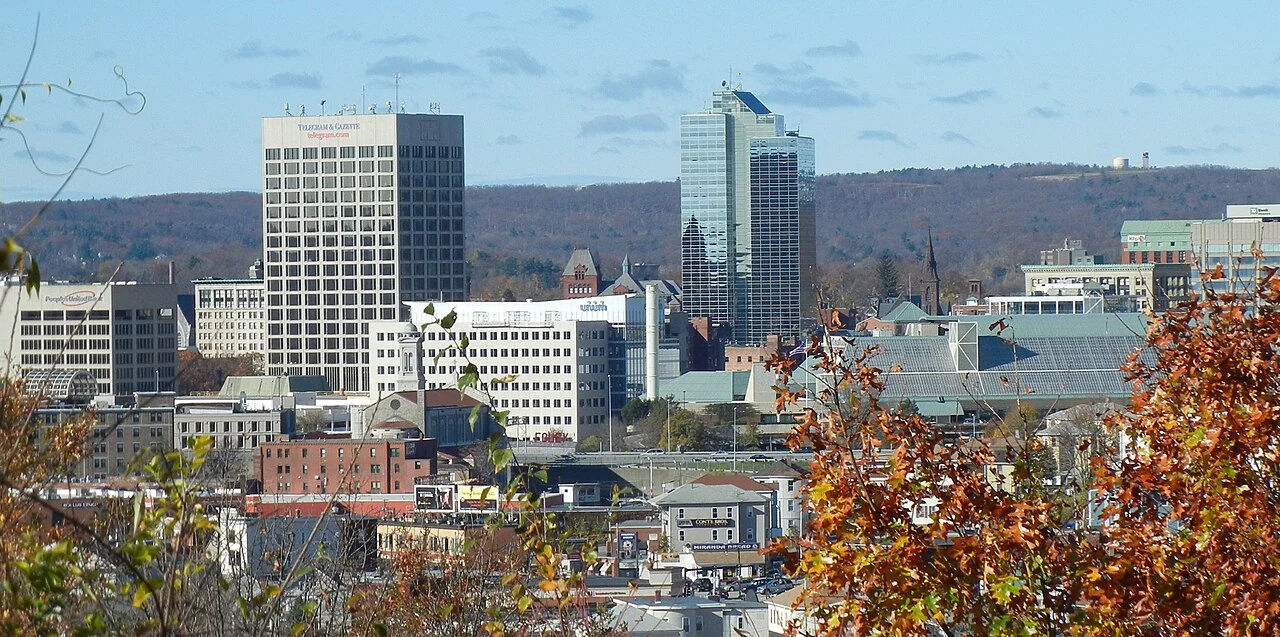
Commercial Roofers in Fitchburg
Commercial roofers serving Fitchburg should document leak sources, wet insulation, drainage, edge details, penetrations, and repair history before recommending a scope. Fitchburg's paper mill legacy left behind a stock of heavy brick industrial buildings along the Nashua River, many now converted to mixed-use, storage, or light commercial space, sitting alongside Fitchburg State University's campus buildings and a scattering of newer industrial construction on the outskirts of the city. The roofing challenges on a converted mill building have almost nothing in common with a university admin building or a modern industrial box, so we walk into every Fitchburg job assuming we'll need a different approach than the last one.
Adaptive Reuse Roofs on Brick Mill Buildings
Converted mill buildings usually kept their original heavy timber or steel truss roof structure, which can carry more dead load than a modern lightweight roof deck but often comes with irregular geometry, exposed brick parapets, and roof penetrations added ad hoc over a century of use changes. Before quoting reroofing on one of these buildings, we map every parapet, chimney remnant, and old mechanical penetration, because these older structures accumulate abandoned roof penetrations that were never properly closed out, and each one is a potential leak path hiding under whatever membrane is currently up there.
Modified bitumen or a fully adhered single-ply system generally suits these roofs better than mechanically fastened membrane, since deck irregularity makes uniform fastener patterns harder to execute cleanly, and a fully adhered system tolerates minor deck variation without the same risk of fastener backout over time.
Historic Parapets and Wind Uplift
Brick parapets on mill buildings weren't engineered to modern wind uplift standards, and the edge metal and membrane termination at these parapets needs careful detailing to avoid uplift failure at the perimeter, which is where we see the most storm damage on this building type. We spec edge metal and termination bar details specifically for the masonry condition on each building rather than using a generic edge detail, since flashing into century-old brick doesn't behave like flashing into a modern parapet cap.
Ice Dams on Older Low-Slope Truss Roofs
Older industrial roof decks in Fitchburg often have less insulation than current code would require, and that gap shows up directly as ice dam problems in winter. Heat escaping through an under-insulated deck melts snow near the roof's warmer interior sections, that meltwater refreezes at the colder perimeter near the parapet, and the resulting ice ridge backs water up under the membrane at exactly the point where the flashing detail is already most vulnerable. Adding insulation during a recover or reroof addresses the root cause rather than just treating the leak symptom every winter.
- Abandoned mechanical penetrations mapped and properly closed before new membrane goes down
- Parapet and edge metal detailing customized to each building's actual masonry condition
- Insulation upgraded during reroof to reduce ice dam risk at under-insulated decks
- Deck load capacity reviewed against original heavy timber or steel truss construction
- Fully adhered membrane favored over mechanically fastened on irregular older decks
Fitchburg State University Buildings
University-owned buildings bring their own scheduling constraints: work needs to avoid disrupting the academic calendar, particularly move-in and exam periods, and any roof section above a dormitory needs the same phased, dry-in-ready approach we'd use on a medical building, since displacing students due to water intrusion is a serious problem for campus operations. We coordinate directly with facilities staff on timing and keep noise and access disruption to a minimum on buildings still in daily use during the work.
Modern Industrial Roofs on the City's Outskirts
Newer industrial and flex-space buildings on Fitchburg's outer edges run standard TPO or EPDM single-ply systems on straightforward low-slope decks, and these are more conventional jobs by comparison, closer in scope to what we'd spec anywhere else in Worcester County. The complexity in this city sits almost entirely in the older building stock, and pricing reflects that: a mill building reroof carries more line-item variability than a standard industrial box because so much depends on what condition survey turns up once we're actually on the roof. We give owners of newer flex-industrial buildings a tighter, more predictable number up front for that reason, since there's far less unknown condition to price around on a straightforward deck built within the last two or three decades.
Fitchburg Roofing Questions
Why do mill building roofs cost more to survey than a standard commercial roof?
A century of ad hoc use changes leaves behind abandoned penetrations, irregular deck framing, and parapet conditions that vary building to building, so we need a thorough physical survey rather than a plan-based estimate.
Can you add insulation to an older roof during a recover rather than a full tear-off?
In many cases yes, provided the existing deck and insulation are dry and sound. Adding insulation thickness during recover is one of the more effective ways to reduce ice dam risk without full replacement cost.
Do you work around the university's academic calendar?
Yes. We schedule around move-in, exams, and other high-occupancy periods and coordinate directly with campus facilities on timing and access.
What causes wind damage at brick parapets on older buildings?
Historic parapets weren't built to modern wind uplift standards, and generic edge metal details don't always anchor properly into century-old masonry, which is why we detail each building's perimeter individually.
How do you know if an old penetration on a mill roof is actually abandoned?
We trace it against current mechanical drawings and building use, and if it no longer serves an active system, it gets properly closed and flashed rather than left as a hidden leak risk under new membrane.